
A trip to Blagaj - the tekke at the source of the Buna
Fifteen kilometres from Mostar, the emerald source of one of Europe's strongest karst springs and a 16th-century dervish tekke. A thorough guide to history, access, etiquette, lunch and photography.
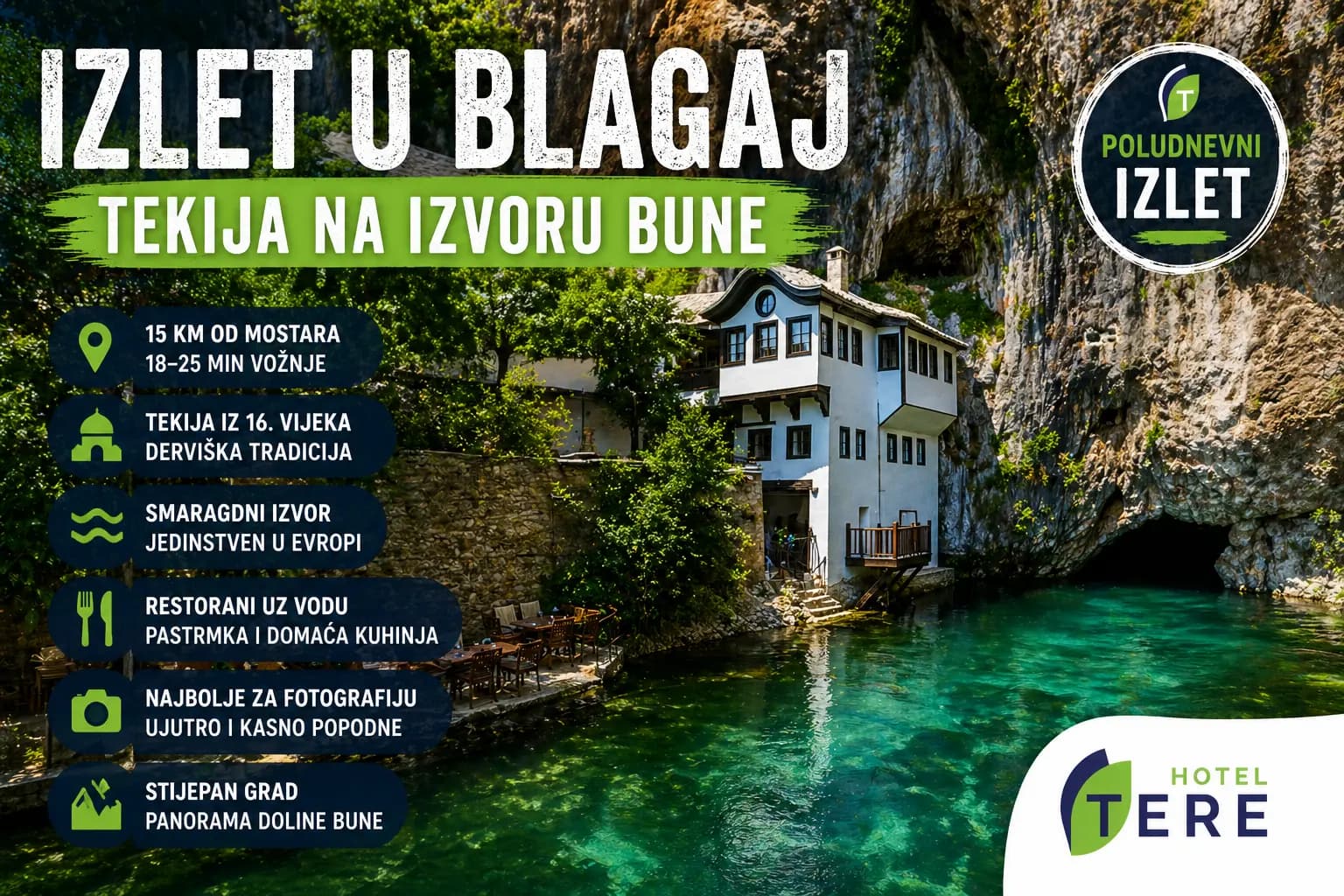
Why Blagaj deserves half a day
Blagaj is one of those places that cannot be described - only seen. Emerald water emerges from a cave beneath a hundred-metre cliff, forms a small pool and immediately becomes the Buna, a short but powerful river that joins the Neretva near the village of Buna nine kilometres later.
There, on the very edge of the water, stands the tekke - a dervish lodge from the first half of the 16th century. The white façade, wooden mashrabiya screens and eaves leaning toward the water make for one of the most photographed views in Bosnia and Herzegovina.
Although the site can be seen in an hour, many visitors stay longer - for lunch beside the water, a walk up to Stjepan grad fortress above the village, or simply for the calm this place offers outside peak hours.
A short history
The tekke at Blagaj was built around 1520 for the Bektashi order of dervishes - a Sufi tradition that held a particular place in the Ottoman Empire, linked to the janissaries and to intellectual life.
The village of Blagaj was a centre of medieval Herzegovina and the seat of Duke Stjepan Vukčić Kosača, after whom the region is named. On the hill above the village stands his fortress - Stjepan grad - visible from almost every point in the valley.
The tekke has been restored several times over the centuries, most recently after serious damage from floods and wartime events. Today it functions both as a museum and as the occasional venue for dervish rituals.
How to get there from Hotel Tere
By taxi: the fastest and most flexible option. A one-way ride takes 18–25 minutes depending on traffic. Reception can call a taxi with a fixed return-trip price including waiting time (we recommend arranging two hours of waiting).
By rental car: practical if you also plan to visit other nearby sights (Počitelj, Hutovo blato, the Kravice waterfalls). Parking in Blagaj is organised at the edge of the village, about 300 metres from the tekke; from there it's a short walk.
By local bus: line 10 runs from central Mostar to Blagaj several times a day. The ride takes about 30 minutes. The schedule changes seasonally - check with reception or at the terminal before setting off.
On an organised tour: in season there are half-day tours combining Blagaj, Počitelj and Kravice. Prices range from 30 to 60 BAM per person depending on duration and meals.
What to see on site
The source of the Buna is best seen from the wooden footbridge in front of the tekke. The water emerges from an underwater cave; divers have measured a depth of more than 200 metres, making it one of the deepest karst springs in Europe.
The tekke is open to visitors for a small entrance fee. The interior is modest but remarkable: a traditional prayer room, kitchen, guest quarters and a small museum with exhibits of dervish culture (cups, rugs, manuscripts).
A path above the village leads to Stjepan grad, the medieval fortress of Duke Stjepan. The climb takes 40–60 minutes, is moderately demanding, and rewards you with a view across the entire Buna valley and the Mostar plain. Bring water, especially in summer.
Etiquette and rules for entering the tekke
The tekke is an active religious site. Shoes are removed at the entrance and placed in the area provided. Women are offered a scarf to cover head and shoulders; men are advised not to enter in shorts (simple wraps are available at the entrance).
Photography is permitted in most rooms, without flash, and without photographing people in prayer. In rooms holding sacred objects, signs indicate when photography is allowed - follow them or ask the guide.
Keep conversation inside the tekke quiet. Mobile phones should be set to silent. Food and drink are not allowed in the rooms.
Restaurants by the water
Beside the tekke are several restaurants with terraces above the water. The local speciality is farmed trout, usually grilled or pan-fried in flour, served with potato and a salad of seasonal vegetables.
For a group dinner or special occasion, some restaurants offer lamb under the sač - to be ordered at least three hours in advance, ideally through hotel reception.
Prices are moderate, with main courses ranging from 18 to 35 BAM. Most restaurants accept cards, but smaller venues are cash-only - bring a few marks just in case.
Best time of day and year
Morning (8–10): the tekke has just opened, there are no crowds, the water is still. Ideal for photography and quiet.
Midday (11–15): peak crowds. If you arrive then, expect tour groups and a wait at the tekke entrance.
Late afternoon (16–18): things calm down again, the light is warmer. A great time if you combine the visit with lunch around 14:00.
Season: April–June and September–October are the most pleasant - mild temperatures and full water flow. July and August are hot (35°C+), so an early start becomes essential. In winter the water is still extraordinarily clear and the tekke in snow looks almost fairytale-like, but some restaurants keep limited hours.
What else to combine with the trip
Počitelj: a medieval fortified town about 30 km south of Mostar, with the Sahat-kula clock tower, the Hadži Alija mosque and a view over the Neretva. Easily combined with Blagaj into a single half-day excursion.
Kravice waterfalls: about 40 km to the south-west, a chain of falls up to 25 metres high with natural bathing pools. A popular summer cooling-off spot.
Hutovo blato: a bird reserve about 50 km from Mostar, with boat trips through marshy lagoons. Particularly interesting for birdwatchers and nature lovers.
Have a question? Our reception is happy to help with tips and arrival logistics.
Contact us